Birding in Ecuador
August 2007
Rick Austin
Our Approach
|
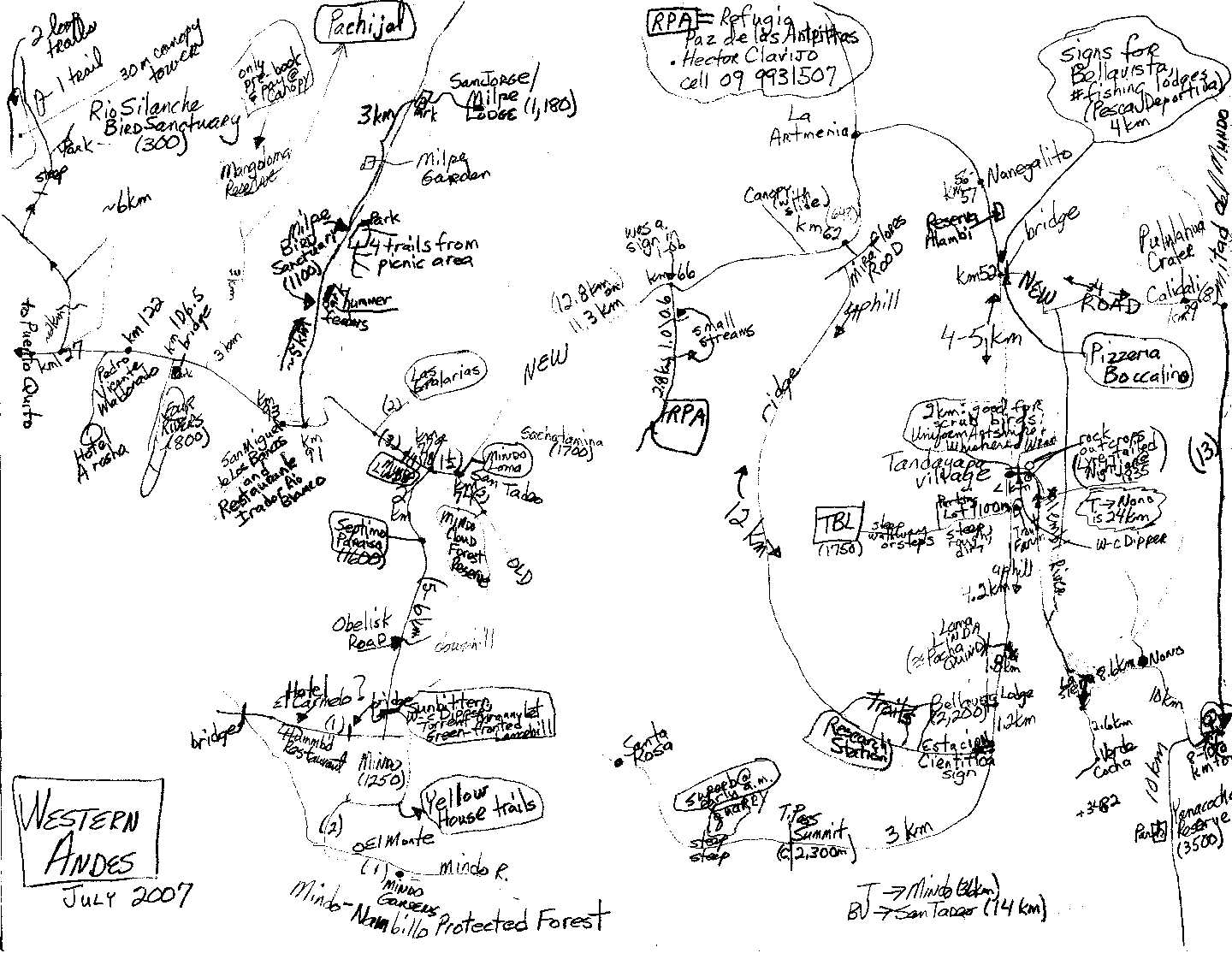
Ecuador? Is it really a spectacular birding alternative to Peru, Costa Rica or Columbia? Yes, absolutely. We spent 3 weeks in Ecuador, July 31 through August 20, 2007. Our interests were varied, but can be summed up as: full-immersion in the cultural environments and natural history of the Andean cloud forests and the Amazon rain forest, accompanied by Peter Martin's extensive photography (i.e. 5,200 digital pictures). Rick birded, Peter shot everything in sight (with his camera), and we both experienced the excitement of living in the moment 24/7. Well, more like 18/7, as we got about 6 hours of sleep nightly. We wanted to experience a trip that avoided the rigidities that are necessary when one is part of a large, organized birding tour. We wanted the flexibilities of independent traveling, and thus we did not book a tour. Yet we wanted extremely knowledgeable guides while in the forests. We were not obsessed with rushing to see the "next" bird. When birds were not plentiful, we wanted to focus on the monkeys, insects or fungi, or the dazzling variety of wild flowers, or the local children. We wanted to take in the entire natural and cultural scene. Our question was: Could all this be done at a reasonable cost? All lodging options were located and booked on-line. Googling " Ecuador birding" quickly brings one to the EcuadorExplorer.com page that presents most of the available options. The lodges we booked cost $80-100 per day (for each of us) and included 3 meals/day. Sacha Lodge costs $870 for a 5-day package, but includes a bird guide and a local guide as part of their package. We arranged a guide for 5 days in the Eastern Andes, but purposely did not book a guide for our initial 11 days in the Western Andes. We wanted to get acclimated "on our own" before following a leader. We wanted to settle into the cloud forest environments at our own pace, then make arrangements for local drivers or guides. We believe guides are essential, to understand and appreciate the beauty and diversity in this country. Transportation from Quito to the Tandayapa Bird Lodge (TBL) was arranged with the lodge ($110 for the two of us). The "driver", Renato Carrillo, was an excellent birder, knew the key birding locations, and was a loquacious companion. He is preparing a bed-and-breakfast on the eastern outskirts of Quito, and can be reached at tato_carillo@andinanet.net. Annabelle Neira, resident manager at TBL, contacted Fabian who we hired as our "driver" for trips throughout the cloud forest locations. He is thoroughly knowledgeable of all aspects of the Western Andes, including the rapid aversion techniques needed to separate oneself from snakes! Fabian also provided transportation to our lodge near the Milpe Bird Sanctuary, and to Rio Silanche and Four Rivers. Twice we hiked the 6 km (uphill all the way) from TBL to the Bellavista Lodge, once enjoying head-lamp views of Lyre-tailed Nightjars flying overhead. On one hike we continued the additional 2 km past Bellavista to bird the road to the Bellavista Research Station. A detailed map of birding locations, distances, and milepost markers does not exist for the Western Andes. Rick reviewed numerous birding trip reports and prepared a map (from Yanacocha Reserve in the east to Rio Silanche, out west). This proved extremely useful. Transportation from San Jorge/Milpe Lodge to Quito/San Jorge Lodge, booked in advance, cost $95 total. George Baquero, the "resident" manager at the lodge, drove us to Quito. If you stay at the San Jorge/Milpe lodge, it is imperative that you know, before you arrive, both the directions to the lodge parking lot (on the right, ~3 km past the Milpe Bird Sanctuary) and the trails to follow to get to the lodge. The San Jorge/Quito lodging cost us $50 apiece. Sacha Lodge arranges the Quito-Coca-Quito air fare (tickets cost $60 each way), and provides a superb combination of experiences. One can be guided through the rain forest by some of the best birding guides in the Amazon basin, or by culturally-oriented guides who have spent their entire lives in the Amazon. Alternately, one can lounge about the lodge grounds. We requested Oscar Tapuy as our birding guide and peppered him with natural history questions. He was phenomenal. On-line, Carmen Bustamante, owner and manager of Cabañas San Isidro (CSI), selected a top-notch guide and birder, Galo Real, to be our guide for 5 days from Quito up to Papallacta Pass and Papallacta Lake, then down to Guango Lodge and CSI. Galo is an excellent naturalist, a repository of cultural information, and an extremely pleasant and thoughtful companion. His wife, Rho Ann, and Carmen handle the day-to-day management of the Lodge, and prepare superb, gourmet meals with Thai, Indian, Italian, French and other themes. Walking the grounds and road beyond Cabañas San Isidro was a delight and produced many fascinating species: guans, tanagers, quetzals, antpittas and solitaires. Birding the interior of each forest demands patience, perseverance and a dedication to "keep pushing onward" to see the next species. Birding the edges is much easier and quickly rewards a birder. However, one does need to "put in one's time" to gain the rewards from the forest interiors. Each day throughout our trip, our alarm awoke us between 4:30 and 5:15 a.m. and we were afield by daybreak, except for one rainy morning in the Eastern Andes. Because of the humidity in most locations, we were glad we purchased wick-drying shirts, pants/shorts, socks and underwear from Bass Pro Shops, Cabelas and REI. Mosquitoes were surprisingly rare, and a quick squirt of DEET was effective the few times it was needed. Between excursions to lodges, we spent nights lodging in Quito at the Hostal de la Rábida. It was very comfortable, quiet, reasonable ($36 each/night), and close to a Telephonica. The Telephonica, containing 4-8 telephone booths, makes e-mailing obsolete, as one can dial 001, area code, and a 7-digit number then connects you to anyone in the United States, for 20-30 cents a minute. The Telephonica are available throughout Quito and many other towns. In sum, every one of our 21 days met or exceeded our expectations. Nothing went wrong; no calamities occurred. The trip cost each of us $4,000, plus air fare. As you can tell, we enjoyed our 3-week journey in Ecuador immensely. |